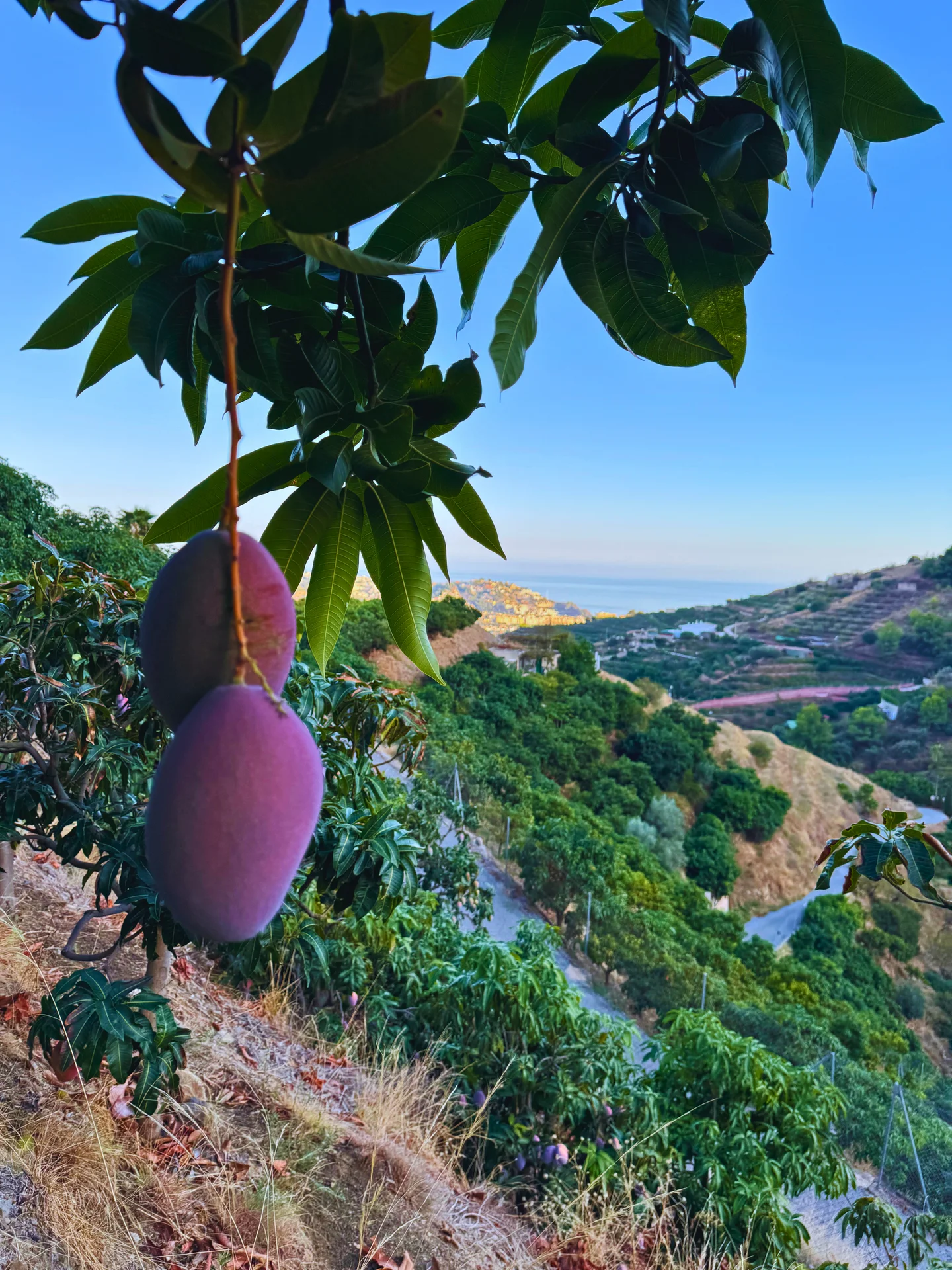
Our origin on the Costa Tropical: three generations growing Spanish mango
Why is the Costa Tropical, Almuñécar, Granada unique for mango?
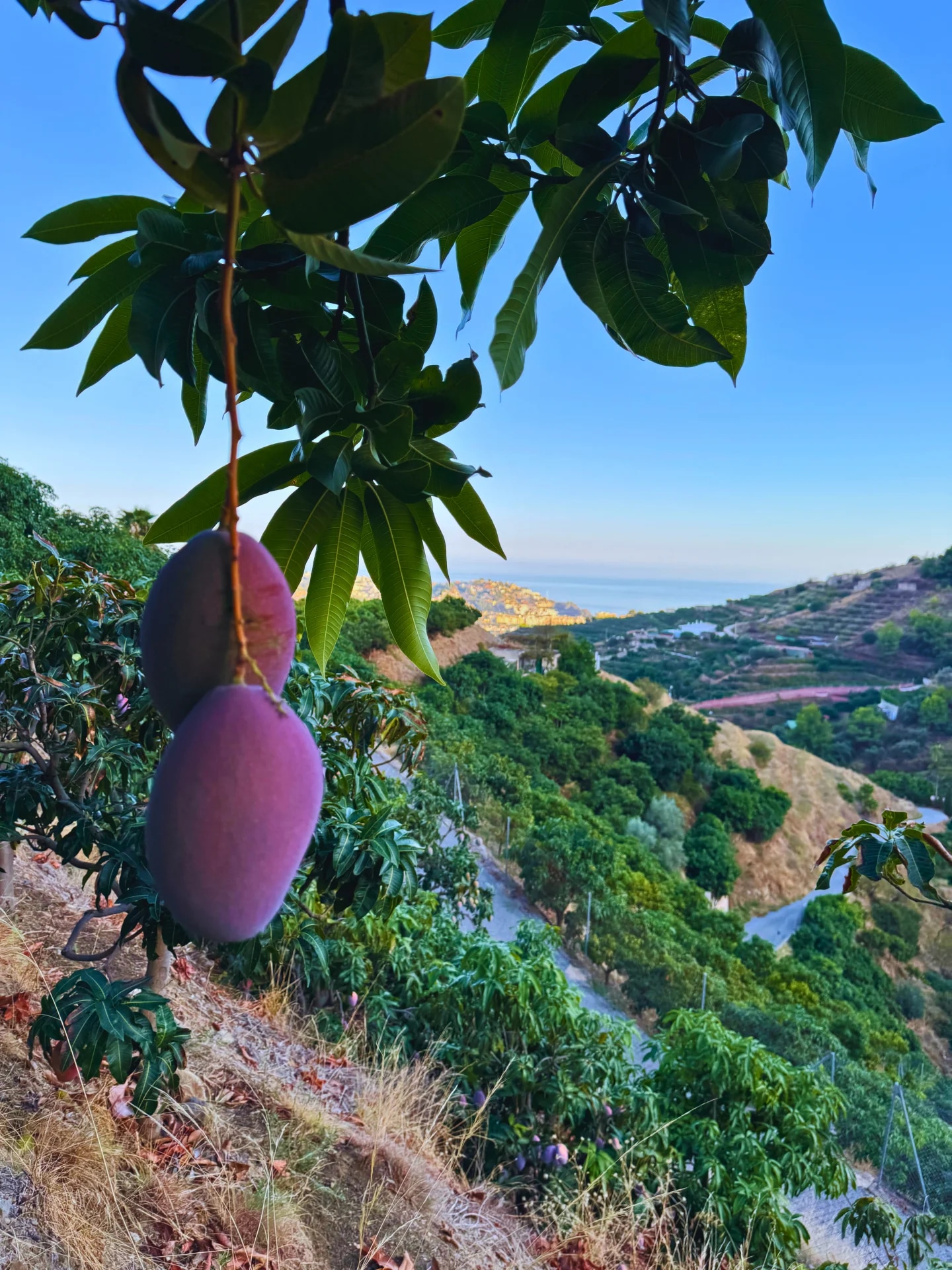
320+ sunny days
Slow, uniform ripening on the tree without artificial rushing
20 °C annual average
No winter frost; mild climate that favours a long cycle
Sierra Nevada as shield
Protects the crop from cold northern continental winds
Mediterranean breeze
Naturally regulates temperature and humidity throughout summer
Fertile alluvial soil
Rich in nutrients carried down from the sierra by mountain rivers
Low rainfall
Intense sun without water excess; optimised drip irrigation
What's the real difference between our mango and the imported one?
How did El Lucero start growing mango in Almuñécar, Granada?
The first trees
A family bet on a crop no one grew in Almuñécar, Granada. The first mango trees were planted where sugar cane used to grow, making the most of the Costa Tropical subtropical microclimate.
Learning and growth
Years of experimentation, learning the microclimate, testing varieties and adapting techniques. The trees matured and the farm established itself as a regional reference.
Focusing on Osteen and Keitt
We chose the two varieties best suited to Almuñécar, Granada's terrain: Osteen (mid-season) and Keitt (late). Quality over quantity.
Chefs discover El Lucero
Restaurants across Spain started ordering our mango. Word of mouth worked: those who tried it came back year after year.
Direct to your table
We removed middlemen. Now you can buy our mango directly, from the farm tree to your home in 24-48 hours across mainland Spain.
Three generations of mango
The grandfather planted the first trees in 1980, unsure if it would work. His sons continued the tradition and learned to master the two premium varieties. The third generation brings the mango directly to your table, cutting out the middleman.
What happens every month of the year on the farm?
Rest
The trees enter winter dormancy. Minimal maintenance and ground preparation for the new cycle.
Flowering and fruit set
The trees flower and fruit set begins. Bees pollinate. Only 1-2% of flowers will become commercial mango.
Pruning
Technical pruning to shape the canopy, improve ventilation and sun exposure. Soil care and nutrients.
Growth
Fruits grow and build up sugar. Controlled precise drip irrigation. Slow ripening = concentrated flavour.
Osteen harvest
Manual harvest, piece by piece. Only when you place an order. We never harvest in advance.
Keitt harvest
The late variety extends the season into November. Fresh Spanish mango through late autumn.
What principles guide our work on the farm?
Respectful natural farming
No rush, no unnecessary chemicals. We respect the biological times of tree and fruit.
Direct from the grower
No middlemen. The same person who grows the fruit answers your WhatsApp messages.
Costa Tropical origin
From our farm in Almuñécar, Granada to your table without intermediate warehouses or prolonged cold chambers.
Sustainability
Efficient drip irrigation, responsible pruning, active support for natural pollinators in the area.
Fair pricing
Fair for you (no middlemen inflating the price) and fair for us (not selling below real cost).
Tree-ripened
Never ethylene chambers or artificial ripening: the mango develops its full sugars and aroma where it should — on the tree.
What should you know about El Lucero's Spanish mango origin?
The El Lucero farm is located on the Costa Tropical in the province of Granada, specifically on the coastal strip between Almuñécar, Motril and Salobreña. This specific area of Spain is the only territory in Europe where the subtropical conditions needed to grow mango outdoors without greenhouses converge.
The farm is an active family operation where every tree is in production during the season. We respect the growing rhythms and every stage of the agricultural cycle, from flowering to harvest, requires careful attention. The location benefits from Sierra Nevada protection to the north and the Mediterranean to the south, creating the unique microclimate that makes premium mango possible.
If you want to know more about how we work or have questions about our growing practices, contact us by WhatsApp or email and we'll be happy to share all the details about our farm and our process.
The key is the unique subtropical microclimate of the Costa Tropical, Almuñécar, Granada, a coastal strip of barely 100 kilometres between Almería and Málaga where four geographical factors converge to make mango cultivation possible without artificial protection: Mediterranean proximity which tempers temperatures, Sierra Nevada protection to the north which blocks cold continental winds, low rainfall that avoids excess humidity, and high sunlight with more than 320 sunny days annually.
These conditions replicate, on a smaller scale, those that mango finds in its tropical zones of origin (India, Central America, Southeast Asia). The difference with those territories is the marked seasonality: our mango has a defined commercial season (August-November) because the mild but noticeable winter slows production between January and July. In purely tropical climates, mango is available almost year-round.
Historically, mango arrived on the Costa Tropical in the 70s when Granada growers experimented with tropical fruits taking advantage of the microclimate. What started as agricultural diversification became fifty years later a recognised producing zone: today 80% of Spanish mango consumed in Spain comes from these Granada and Málaga farms.
Harvest is manual, selective and to order. At Mangos El Lucero we never use mechanical vibrators or mass harvesting methods. Each piece is individually assessed on the tree before cutting the peduncle with specific scissors that leave a clean cut without tearing the fruit's skin. With over forty years of experience, we know our farm and can detect the optimal point of each piece.
The selection criterion combines four signals applied at harvest: skin colour and tone (different in purple-red Osteen and in green Keitt), final shape and size of the piece (we reject too-small or too-large pieces indicating irregular ripening), aroma when bringing the nose close to the peduncle, and firmness on gentle touch. A piece that passes all four criteria goes to the customer's box; one that fails on any stays on the tree a few more days or is discarded for own consumption.
Once cut, the mango goes immediately to protective packaging that prevents blows during transport. We don't store harvested fruit awaiting a customer: if there's no order, we don't harvest, because fruit in a chamber loses precisely the properties that differentiate us. Harvest to order is what ensures the mango arrives at your home with the same ripeness point it would have if you picked it yourself from the tree.
Climate change is a reality we've directly observed on the farm over the past decade. Winters are progressively milder, which theoretically favours mango (tropical fruit), but new meteorological phenomena also appear that complicate production: extreme heat waves during April-May flowering that can reduce fruit set, localised torrential rains at critical fruit growth moments, and pests that previously didn't reach the area and now survive the mild winter.
Our responses have been pragmatic and progressive: we've partially changed irrigation techniques to adapt to greater summer evaporation, we've brought forward some winter pruning operations, we've reinforced biological control of new pests (thrips, scale insects) and we maintain constant vigilance over flowering to detect anomalous phenomena. We've also started experimenting with complementary varieties of different cycles as insurance against years with problems in Osteen or Keitt.
The long-term concern is not so much whether mango can continue to be grown on the Costa Tropical by 2050 (probably yes and with greater yield due to milder winters), but whether punctual irregular conditions (extreme heat, prolonged droughts, violent rains) will compromise quality and regularity year after year. It's a topic we frequently discuss with other farms in the area and with agricultural technicians.
The main misunderstanding is thinking that any mango labelled Spanish in a supermarket is equivalent to what a farm like El Lucero represents. The origin label only indicates the product's final provenance but says nothing about agricultural practices, cold chain, time between harvest and sale, or the distribution model. A mango grown in Almuñécar, Granada but distributed through standard chain can take two or three weeks from harvest to supermarket shelf, time enough to lose almost all differential properties.
The second frequent misunderstanding is underestimating the time factor. Many people believe the difference between imported and Spanish mango is genetic or climatic. Genetically they're usually the same variety (Osteen, Keitt, Tommy Atkins are international). Climatically there are differences but not huge ones. The fundamental difference is time from branch to plate: 24-48 hours in our case, 15-30 days in imports. That temporal factor determines real flavour, aroma and texture.
The third misunderstanding is thinking that harvested to order is a marketing slogan. It's literally operational: when your order enters our system, we go to the tree that same week to cut mangoes specifically for your box. There's no accumulated stock waiting for a customer. This model has clear advantages (maximum freshness) and real disadvantages (less urgency flexibility, limited volume), but it's not advertising exaggeration: it's exactly how Mangos El Lucero has worked since it exists.
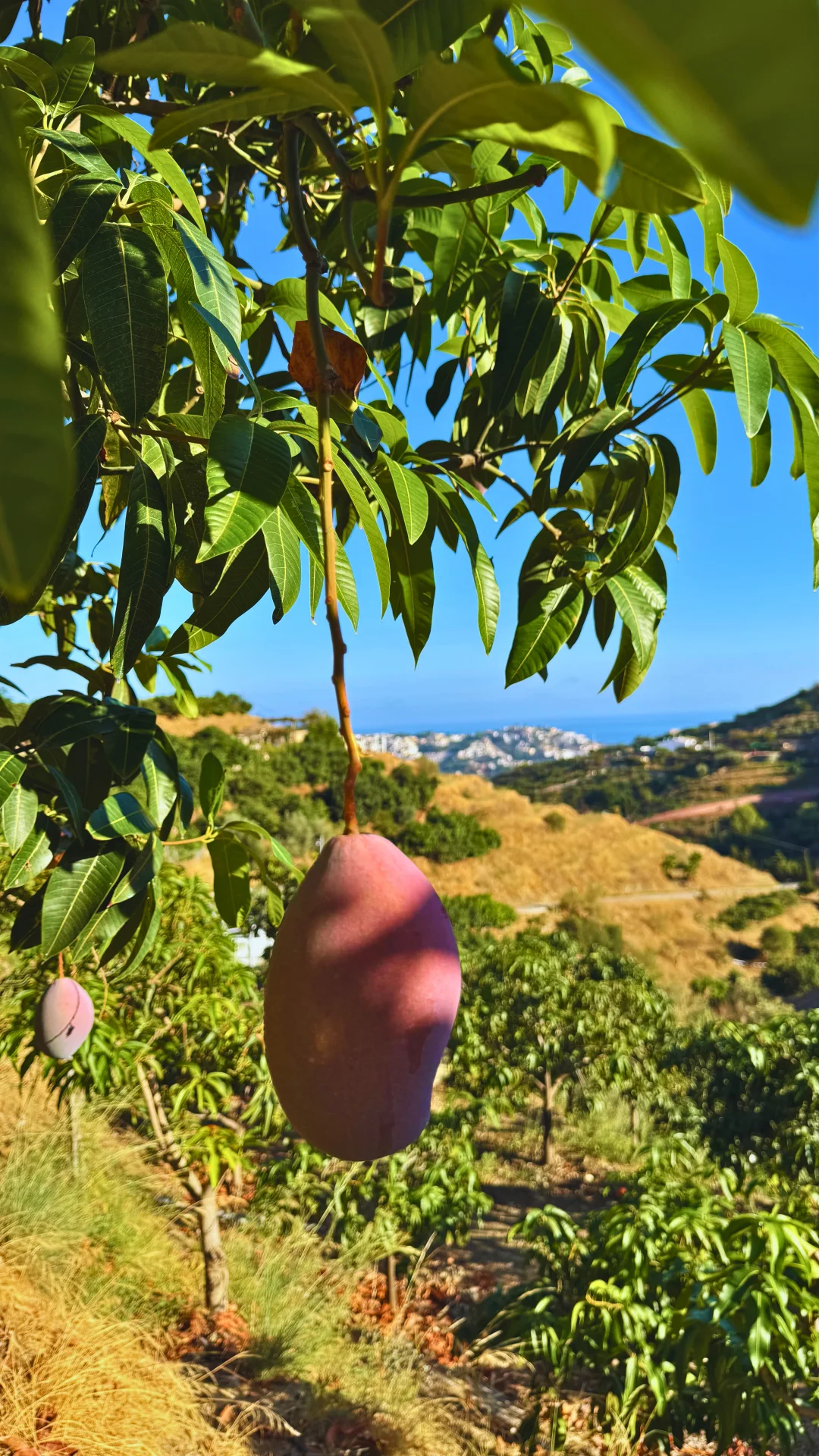
Ready to try real Costa Tropical mango?
Every mango leaving our farm carries forty years of experience, the Costa Tropical of Almuñécar, Granada sun and the care of a family that lives by and for this fruit. Taste the difference.
"Try it and you'll understand." — The El Lucero family, growers since 1980