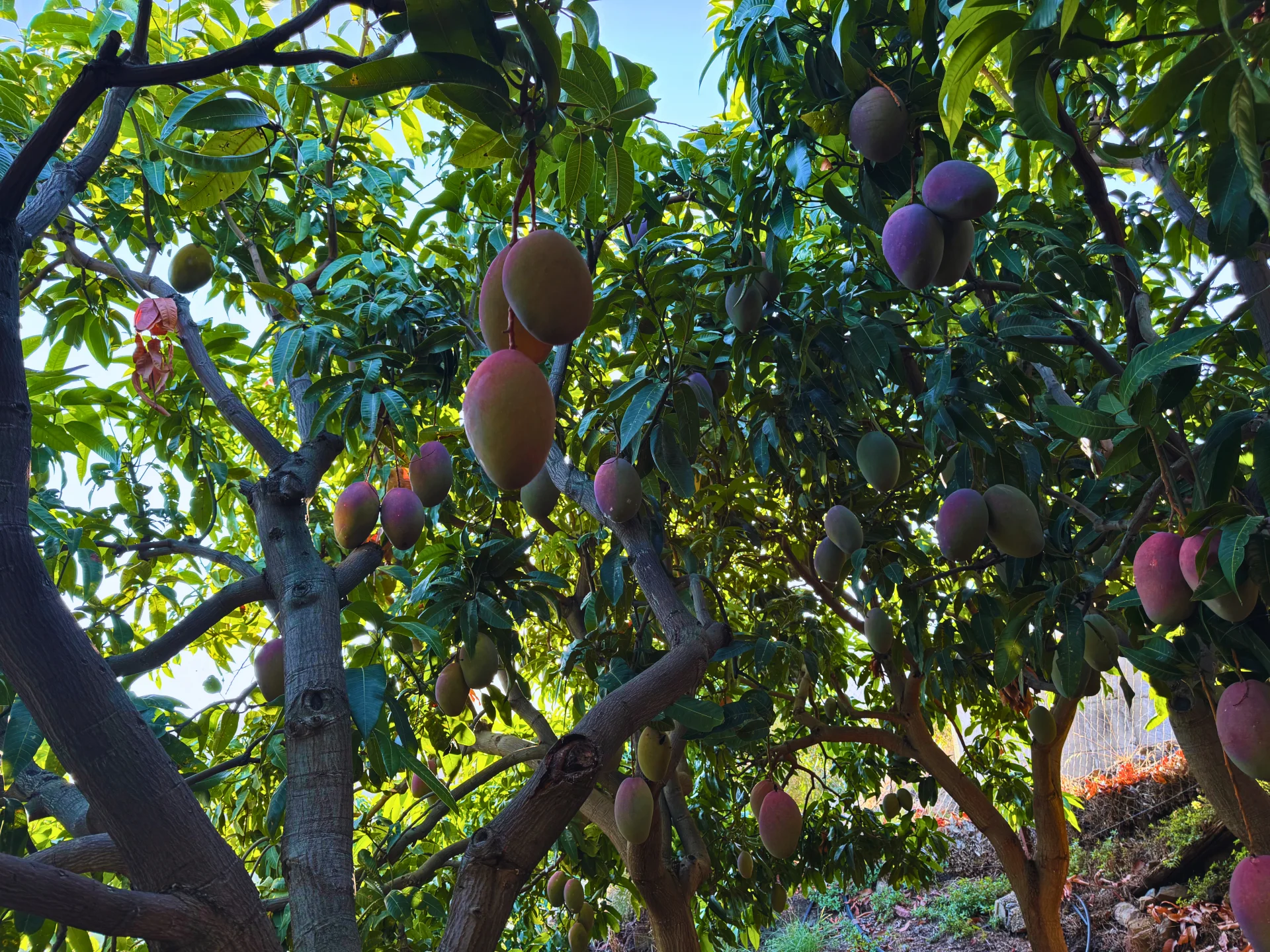
A lot of people think Spanish mango "happens in summer". It's a dangerous simplification that, if you follow it, will have you buying imported mango in July and August exactly when there is no domestic fruit, and will make you miss the real season when it finally kicks in. Let's break it down.
The surprising truth: Spanish mango is an autumn fruit
The mango grown in Spain — essentially all of it on the Costa Tropical, Almuñécar, Granada (and the Málaga coast) — is not a July fruit, nor a whole-of-August fruit, let alone June. It's a late summer and autumn fruit. Season runs roughly from mid-August to late November, with the real peak between September and October.
The reason is climatological and natural. Mango needs a very specific sequence to deliver quality fruit:
- Spring bloom (March-April). Hundreds of white flowers per tree; only a fraction sets.
- Fruit set (April-May). Fertilized flowers begin forming tiny fruit.
- Sizing up (May-August). All summer the fruit gains size. It's not eaten here: still hard, green and acid.
- Ripening on the tree (August-November depending on variety). Nights cool down and the fruit develops sugar and aroma.
When you see mango in the supermarket in July, it's not Spanish: it comes from Brazil, Peru, Ivory Coast or Senegal. Picked green two or three weeks ago, shipped by sea, and gas-ripened with ethylene in transit. It's not bad as cheap fruit, but it has nothing to do with the flavor of mango grown here.
Real Spanish mango calendar, month by month
🟢 June and July: no fresh Spanish mango
Trees are busy with fruit sizing up — still green and hard. No harvest. If you buy mango in those months, it's not domestic, whatever the label says.
What to do: book a pre-order. Drop us a line and we'll let you know the day harvest starts. Free, no commitment.
🟡 First half of August: shy start
The earliest Osteens start ripening in the sunniest plots. We're talking small batches: harvest is not yet massive and shipments go to a waiting list.
What to expect: pieces around 350-450 g, already good flavor but not peak. Ideal for the impatient who've been waiting since January.
🟠 Second half of August through all September: Osteen at peak
In our opinion, the best stretch of the year for Spanish mango. Osteen ripens across the whole farm, pieces hit their optimal size (400-600 g), and the balance between sugar and acidity is exactly what the variety promises.
Nights are already cooling — 14-16 °C — which concentrates sugars in the fruit (same reason mountain wines are more aromatic).
What to order: any Osteen box. If this is your first tasting of our mango, this is what you order.
🟠 October: Osteen-Keitt overlap
Last good third of Osteen and the start of Keitt. For three or four weeks both varieties coexist. It's the period when most customers order a box of each variety because they like to compare.
What to order: one Osteen box and one Keitt box. Taste both, decide which one you prefer, and in November order only that one.
🟢 November: Keitt in full form and season's close
Osteen steps aside. Keitt is the undisputed king. Large pieces (500-900 g), very juicy, ideal for smoothies, desserts and those meat dishes with mango chutney that in November hit the spot more than in September.
The aromatic profile of November Keitt differs slightly from October's: deeper, less sugary, with notes closer to ripe melon. Cool autumn nights work in its favor.
It's the last month of the season: the harvest tapers off and the final trees yield their last pieces toward late November. After that, silence until next August.
What to order: Keitt straight — and sooner rather than later, because once it's gone, it's gone until next year.
⚫ December to July: off season
No fresh Spanish mango. Period. If a site or shop sells "Spanish mango" in March, it's either dried / frozen from last season or it's not Spanish. There is no technical way to produce fresh mango outside those four months here.
What to do: join the pre-order list for the next season. We'll email you in August and you get priority over newcomers.
Why don't you ripen in a chamber to extend the season?
We could. We don't. Simple reason: a mango picked green and gassed with ethylene in a chamber never has the flavor of one ripened on the tree. Technically the chamber gets it soft and color-right, but the sugars don't finish developing the same way. You end up with fruit that's "ripe" to the touch but cardboard on the palate.
We'd rather have a short real season than mediocre mango all year. Bad commercial decision, good ethical one.
How to plan your year as a smart buyer
If you're new
Order in September. Osteen, 4 kg, for yourself or to share with neighbors. Cleanest entry to the world of real mango.
If you already know domestic mango
Order throughout the whole campaign. Osteen in September, a box of each variety in October, Keitt in November. Repeating every 3-4 weeks is the closest thing to "having mango season at home".
If buying for gifts or corporate
Best gifting window: September to November. Book at least a week ahead, two if it's multiple addresses.
If you find us off-season
Sign up for pre-order. It's free, no payment yet, and the day harvest starts you get an email. Your orders go before those of people showing up in mid-September for the first time.
Small grower's secret
The best mangoes of the year are usually from mid to late September. Nights are starting to cool, days are still warm and long, and the fruit gets that daily thermal contrast that concentrates flavor. If you're only going to taste once, taste then.
Check the current season status in the shop — we update variety availability as harvest progresses.