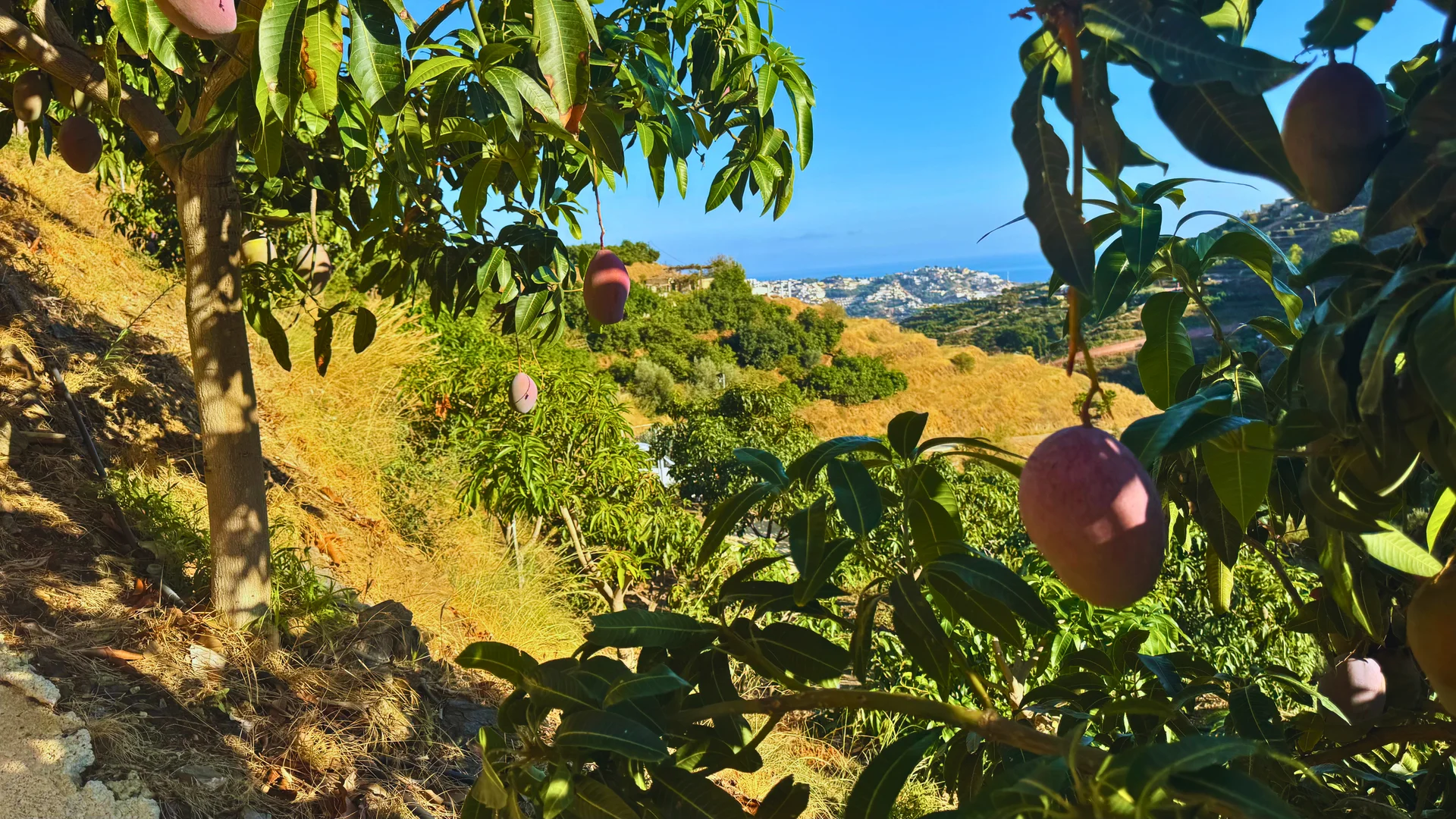
The Costa Tropical — the 100 kilometer coastline between Almuñécar and Nerja — is a geographic oddity. On any climate map, this strip is marked with a colour that matches neither the rest of Andalusia nor the rest of Europe. It's subtropical. And for mango, that changes everything.
A huge backrest: Sierra Nevada
To understand why mango grows here, start by looking north. Less than 40 kilometers from the sea rises Sierra Nevada, the roof of the Iberian Peninsula, with peaks above 3,400 meters snow-capped most of the year.
That wall does two essential things:
- It blocks cold northern winds in winter. When inland Granada hits frosts of -5 °C, here we keep nights at 10-12 °C and sunny days. That difference — barely 60 km in a straight line — separates two climatic worlds.
- It stores water as snow that it slowly releases to coastal valleys and aquifers during summer, exactly when the mango needs it. Our irrigation water comes from the sierra — it's neither pumped nor desalinated.
A sofa in front: the Mediterranean Sea
To the south we have the Mediterranean, acting as a giant thermoregulator. Water takes much longer than land to warm up and cool down, so it smoothes summer extremes and winter cold. The sea is, literally, a thermal battery.
Result: low thermal amplitude year-round. Mild winters without frost, warm but not sweltering summers, and — key for flavour — cool nights even in summer, which concentrate sugars and aromas in the fruit.
Microclimate numbers
| Parameter | Costa Tropical | Inland Granada | Central Spain |
|---|---|---|---|
| Average annual temperature | 18-19 °C | 15 °C | 14 °C |
| Days of sun per year | 320 | 280 | 270 |
| Frosts per year | 0-1 | 40-60 | 60-80 |
| January average | 12-13 °C | 6-7 °C | 5 °C |
| August average | 25-26 °C | 26-27 °C | 26-28 °C |
| Summer day/night amplitude | 8-10 °C | 15-18 °C | 15-20 °C |
| Relative humidity | 65-70 % | 40-50 % | 35-45 % |
The rows that matter most for mango are the last two: relative humidity and thermal amplitude. Mango is a fruit tree that loves moderate humidity and nights softer than a desert. Inland Spain has scorching summers but nights too cold for mango, and very low humidity. Here it doesn't.
Quick history: from cane to mango
The tropical vocation of this coast is nothing new. Sugar cane was grown here after the Arabs introduced it in the 10th century. For over eight hundred years this was Europe's main sugar region — before the Americas started industrial production.
When cane ceased to be profitable in the late 20th century (competition from European beet and tropical sugar from Brazil and the Caribbean), local farmers found themselves holding land worked for generations, well-managed aquifers, and a climate begging for subtropical crops: avocado, cherimoya, kumquat, loquat, papaya... and mango.
The first experimental mango trees reached the Costa Tropical in the 1960s, but serious plantations didn't come until the 1980s. Our family planted the farm's first trees in 1980, among the Osteen pioneers in Spain.
Terroir: what it means in practice
"Terroir" is a word the French use for wines and we borrow for mangoes. It refers to the unique combination of soil, climate, altitude and human management that makes fruit grown in one place impossible to replicate in another.
Costa Tropical terroir has four ingredients:
- Light, well-drained soils of volcanic and alluvial origin. Mango hates waterlogging and loves deep roots. It gets both here.
- Predominantly south-facing hillside plots. Many hours of direct sun without the murderous midday beating of August.
- Sierra Nevada water. Meltwater, slightly acidic pH, low mineralization — exactly what the tree likes.
- Accumulated experience. 40-50 years of experience in local farming families, learning which varieties work, how to prune, how to irrigate.
What does this mean for your mango?
Microclimate isn't a tourist brochure detail. It translates into very concrete things you taste on the first bite:
1. Real tree ripening
Without frost or extremes during the harvest season (August to November), we can leave fruit on the tree until sugar and aroma fully form. Other origins (Brazil, Peru, Africa) pick green out of necessity: fixed shipping dates, imminent frost, or contracts with distribution chains don't allow waiting.
2. More concentrated flavour
Cool September and October nights make the mango concentrate sugars and aromas. Same phenomenon as altitude wines: daily thermal contrast mildly stresses the plant and it responds by loading fruit with flavour compounds.
3. Zero post-harvest treatment
No need to gas with ethylene or run fruit through a ripening chamber, because it doesn't come in green. It leaves the tree ready to eat — at most a day or two to fine-tune to consumer preference.
4. Short kilometers
Fruit leaves the farm and reaches your home in 24-48 hours within mainland Spain, 48-72 hours elsewhere in Europe. Imported fruit has been on a ship for two or three weeks. Time is the enemy of ripe mango flavour.
The future: climate change and mango in Europe
With climate change there's more and more talk of "planting mango in other parts of Spain" (Málaga does it, Valencia is starting). The reality is yes, climate is warming and more areas will be able to grow subtropicals. But for gourmet quality, what matters isn't just average temperature: it's never having frost, soft humidity, low thermal amplitude, well-drained soil and tradition.
On those points the Costa Tropical will remain unbeatable for many decades to come.
A place worth visiting
The Costa Tropical doesn't only produce mango. It also produces avocado, cherimoya, papaya, guava, carambola, dragon fruit... If you're ever in the area between September and November, ask us to show you the farm. Seeing trees loaded with ripe fruit facing the sea, with snow-capped Sierra Nevada behind, helps you understand why this place is special.
We arrange guided visits with small groups during the season. We pick fruit from the tree, show the selection process, and of course, we taste.
More about our farm, our history and how we work on the origin page.
Sources and references
Data on the Costa Tropical subtropical microclimate:
- AEMET — Spanish Meteorological Agency — Climate profile of Almuñécar and Motril
- CSIC La Mayora (Málaga) — Research on continental Europe's only subtropical microclimate
- FAO — Agroclimatic requirements for mango cultivation
- MAPA — Spanish Ministry of Agriculture — Subtropical production zones in Spain